

1 Like
"Là fuoresce il tritone dai flutti che lambiscono le soglie d’un cristiano tempio, ed ogni ora prossima è antica. Ogni dubbiezza si conduce per mano come una fanciulletta amica.
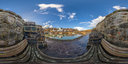
Nella parte più occidentale del golfo di La Spezia si trova lo stupendo borgo di Portovenere. Prende il nome da un tempio eretto in onore di Venere Ericina, in epoca romana, costruito sull'attuale promontorio di San Pietro. Proprietà dei signori di Vezzano, venne acquistato da Genova nel 1113, che diede al borgo l’aspetto attuale con la costruzione del castello su una fortificazione preesistente, la cinta muraria le case torri dai tipici colori liguri.
Portovenere conserva inoltre la torre capitolare, a sinistra della porta d'ingresso a via Capellini, la via principale anche chiamata il Carugio, Piazza Spallanzani, dove sorgeva l’antico centro preromano del Castrum Vetus, la chiesa di San Pietro, all’estremità del promontorio e la chiesa di San Lorenzo in collina.
Davanti a Portovenere si trova l’arcipelago con le tre isole, Palmaria, Tino e Tinetto, parte del "Parco Naturale Regionale di Porto Venere". Il Tino e il Tinetto conservano antiche vestigia dell'XI secolo e del VI secolo rispettivamente. Il Tino è Zona Militare ed è accessibile solo per la festività in onore di San Venerio, il 13 settembre. L’isola Palmaria, separata da Portovenere da uno stretto braccio di mare, detto "Le Bocche", è la più visitata turisticamente, con interessanti valori naturalistici di tipo mediterraneo.
da www.terredilunigiana.com
Liguria borders France to the west, Piedmont to the north, and Emilia-Romagna and Tuscany to the east. It lies on the Ligurian Sea. Liguria is a narrow strip of land, enclosed between the sea and the Alps and the Apennines mountains, it is a winding arched extension from Ventimiglia to La Spezia and is one of the smallest regions in Italy. Its surface area is 5,416.03 square Kilometres, corresponding to 1.18% of the whole national surface area, with the following subdivision: 3524.08 kilometres mountain (65% of the total) and 891.95 square kilometres hill (35% of the total).Its shape is that of a thin strip of land, from 7 to 35 Km wide (respectively above Voltri and in the high mountain area around Imperia), on average about 240 Km long, lying in a semicircle around the Ligurian Sea and with convexity facing north; comprised between the sea and the watershed line of the Maritime Alps and the nothern Apennines, which at some points it crosses (for example in the Savona and Genoa mountains). Some mountains rise above 2000 m.; the watershed line runs at an average altitude of about 1.000 metres.The continental shelf, which is very narrow, goes down almost immeditely to considerable marine depths. The coastline is 315 Km long. Except for the Portovenere and Portofino promontories, it is generally not very jagged, and is often high and compact. At the mouths of the biggest watercourses there are small beaches, but there are no deep bays and natural harbours except for those of Genoa and La Spezia.The hydrographic system is made up of the short watercourses of a torrential kind. In the coastal part the most important are the Roja (in its lower course), the Nervia, and the Magra. On the inland side we find some tributaries of the Po: the two branches of the Bormida, the Scrivia and the Trebbia; there is not much water in these rivers, though the quantity increases greatly in rainy periods.The ring of hills, lying immediately beyond the coast, together with the beneficial influx of the sea, account for the mild climate the whole year round (with average winter temperatures of 7-10° and summer temperatures of 25-28°) which makes for a pleasant stay even in the heart of winter.Rainfall can be very abundant at times; mountains very close to the coast create an orographic effect, so Genoa can see up to 2000 mm of rain in a year; other areas instead show the normal values of the Mediterranean area (500-800 mm). Despite the high population density, woods cover half of the total area. Liguria's Natural Reserves cover 12% of the entire Region, i.e. around 60,000 hectares of land, and they are made up of one National Reserve, six large parks, two smaller parks and three nature reserves. http://en.wikipedia.org/wiki/Liguria