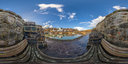
Titova Pećina, Drvar
Share
mail
License license
loading...
Loading ...

Panoramic photo by Bane Obradović EXPERT Taken 13:43, 02/05/2012 - Views loading...

Titova Pećina, Drvar

The World > Europe > Bosnia and Herzegovina

  • Like / unlike
  • thumbs up
  • thumbs down


Tito's Cave (Titova pećina) is a small cave of little speleologic interest. There is a path from Drvar, with many steps, up the hill to the cave entrance. The cave has a nice view across the city of Drvar. During spring there is a cave river flowing out of the cave, so it is impossible to visit the cave during snow melt. The rest of the year the cave is dry.

The great importance of this cave is its history. It was the hideout of Tito (Josip Broz) and his communist partisans at the end of World War II. During Operation Rösselsprung (Knight's Leap) the Germans attacted Dvar. It was one of three occasions where the Germans were close to kill Tito. However, despite the massive attack they could not catch him. A legend tells he was saved by his loyal dog, who sacrificed himself.

Later in communist Yugoslavia this cave was a sort of national shrine and a popular tourist destination. During this era the town Drvar, where it is located, was renamed Titov Drvar. During the war the cave was abandoned and almost forgotten. Now, in the attempt to intensify tourism in Bosnia and Herzegovina, the cave was refurbished and reopened. The renovation was made by Drvar authorities, supported by the United States Agency for International Development (USAID).

comments powered by Disqus

Nearby images in Bosnia and Herzegovina

map

A: Pogled Ka Uni

by Bane Obradović, 22.7 km away

Pogled Ka Uni

B: Veliki Buk Martin Brod

by Bane Obradović, 22.8 km away

Veliki Buk Martin Brod

C: Una waterfalls

by Bane Obradović, 22.8 km away

Una waterfalls

D: Vodopad Nakon Odrona

by Bane Obradović, 22.8 km away

Vodopad Nakon Odrona

E: River Una

by Bane Obradović, 22.9 km away

Beatiful river Una

River Una

F: Slapovi Une, Martin Brod

by Bane Obradović, 23.0 km away

Slapovi Une, Martin Brod

G: Manastir Rmanj Martin Brod

by Bane Obradović, 23.0 km away

Rmanj monastery in Martin Brod, in the picturesque area of the confluence of the Una ounce, it is the...

Manastir Rmanj Martin Brod

H: Veče u Čardaklijama

by Bane Obradović, 32.9 km away

"Cardaklije" is where you can live and work as in used to be in a traditional rural household, a plas...

Veče u Čardaklijama

I: Cardaklije

by Bane Obradović, 33.0 km away

Cardaklije

J: Cardaklije Etno Selo

by Bane Obradović, 33.0 km away

Cardaklije Etno Selo

This panorama was taken in Bosnia and Herzegovina, Europe

This is an overview of Europe

Europe is generally agreed to be the birthplace of western culture, including such legendary innovations as the democratic nation-state, football and tomato sauce.

The word Europe comes from the Greek goddess Europa, who was kidnapped by Zeus and plunked down on the island of Crete. Europa gradually changed from referring to mainland Greece until it extended finally to include Norway and Russia.

Don't be confused that Europe is called a continent without looking like an island, the way the other continents do. It's okay. The Ural mountains have steadily been there to divide Europe from Asia for the last 250 million years. Russia technically inhabits "Eurasia".

Europe is presently uniting into one political and economic zone with a common currency called the Euro. The European Union originated in 1993 and is now composed of 27 member states. Its headquarters is in Brussels, Belgium.

Do not confuse the EU with the Council of Europe, which has 47 member states and dates to 1949. These two bodies share the same flag, national anthem, and mission of integrating Europe. The headquarters of the Council are located in Strasbourg, France, and it is most famous for its European Court of Human Rights.

In spite of these two bodies, there is still no single Constitution or set of laws applying to all the countries of Europe. Debate rages over the role of the EU in regards to national sovereignty. As of January 2009, the Lisbon Treaty is the closest thing to a European Constitution, yet it has not been approved by all the EU states. 

Text by Steve Smith.

Share this panorama