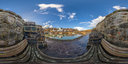
Viborg Cathedral at the Altar |
||
Archaeological excavation indicates that a church has been situated here since the Viking Age (approximately 1130). The present cathedral dates from 1876 and is one of the largest granite churches in Northern Europe. Inside, the cathedral is decorated with impressive murals - an enormous picture bible - painted by Joakim Skovgaard.
Archaeological excavation indicates that a church has been situated here since the Viking Age (approx...
on a trip along my former place of work, the Danish railways, i came to Rindsholm fish farm, at the s...
I the early springtime i visited Rindsholm, one of my railway-places. There was no longer something o...
Trying to make HDR-pictures i travelled up to Viborg, and found some nice places. I did learn, that i...
Here it is clearly to see, how the wind mooves some of the branches, mostly on the right side of the ...
Nice weather, so i made at trip to Tange lake ...
This is the "beach" of Tange Town!Lake Tange is an artificial lake to the old powerplant at Tange, n...
Lake tange, an artificial dam lake and the purpose was to deliver powe to the powerplant Tangeværket,...
For 25 years I was employed by the Danish State railways, and this gave me an invaluable possibili...
Europe is generally agreed to be the birthplace of western culture, including such legendary innovations as the democratic nation-state, football and tomato sauce.
The word Europe comes from the Greek goddess Europa, who was kidnapped by Zeus and plunked down on the island of Crete. Europa gradually changed from referring to mainland Greece until it extended finally to include Norway and Russia.
Don't be confused that Europe is called a continent without looking like an island, the way the other continents do. It's okay. The Ural mountains have steadily been there to divide Europe from Asia for the last 250 million years. Russia technically inhabits "Eurasia".
Europe is presently uniting into one political and economic zone with a common currency called the Euro. The European Union originated in 1993 and is now composed of 27 member states. Its headquarters is in Brussels, Belgium.
Do not confuse the EU with the Council of Europe, which has 47 member states and dates to 1949. These two bodies share the same flag, national anthem, and mission of integrating Europe. The headquarters of the Council are located in Strasbourg, France, and it is most famous for its European Court of Human Rights.
In spite of these two bodies, there is still no single Constitution or set of laws applying to all the countries of Europe. Debate rages over the role of the EU in regards to national sovereignty. As of January 2009, the Lisbon Treaty is the closest thing to a European Constitution, yet it has not been approved by all the EU states.
Text by Steve Smith.