

1 Like
NASA's Mars Exploration Program (Image credit: NASA/JPL-Caltech/MSSS)
Sol 4656: Boxworks With a View
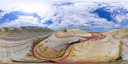
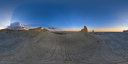
The images for panorama obtained by the rover's 34-millimeter Mast Camera. The mosaic, which stretches about 30,000 pixels width, includes 324 images taken on Sol 4656 (2025-09-11).
Curiosity continues to image, analyze, and traverse through a landscape characterized by higher standing ridges separating low-lying depressions (hollows) — a surface known as the boxwork terrain on Mount Sharp. The science team is actively characterizing the texture, chemistry, and mineralogy of the ridges and hollows to understand how this surface formed and changed over time. I served as the Geology theme group “Keeper of the Plan” for Sols 4656-4657 where I compiled the details for each scientific activity that will be carried out by the rover. I selected the particular Navcam image accompanying this blog post because it not only shows the intriguing boxwork terrain beneath our wheels but also highlights the striking wind-sculpted yardangs on our exciting route ahead.
Our successful drive over the weekend set us up nicely to investigate the bedrock ridge in the workspace directly in front of the rover on Sol 4655. The target “Chango” was selected for closer inspection with the dust removal tool (DRT) and APXS and MAHLI instruments. ChemCam used its LIBS instrument to analyze the chemistry of a bedrock ridge at the “Quechua” target, and Mastcam and ChemCam included several mosaics to document walls of nearby hollow interiors, fractures, and the hollow-to-ridge transitions. The plan for Sols 4656-4657 focused on a variety of remote sensing activities including a 360-degree mosaic by Mastcam — one of the most spectacular data products! ChemCam investigated the local bedrock and a raised resistant bedrock feature at “Chita” and “Chaco,” respectively, and then turned its sights to the distant floor of Gale crater to image features that may have formed when water eroded material from the interior walls of the crater rim. Planning on Friday for Sols 4658-4660 included three targeted science blocks to dig deeper into the boxwork unit. ChemCam LIBS will analyze the bedrock at targets “Tarata” and “El Sombrio” and a rock that does not look like typical bedrock at “Cobres.” The Mastcam team assembled multiple images and mosaics that will help decipher the distribution of veins, fractures, and nodules (somewhat rounded features) in the bedrock, as well as small sand dunes in and around the workspace. The environmental theme group worked throughout the week to monitor clouds and dust-devil activity, and planned Mastcam tau observations to assess the optical depth of the atmosphere and constrain aerosol scattering properties. Written by Sharon Wilson Purdy Other panoramas of Mars by Curiosity rover:
Planetary Geologist at the Smithsonian National Air and Space Museum
...




The planet Earth has proven to be too limiting for our awesome community of panorama photographers. We're getting an increasing number of submissions that depict locations either not on Earth (like Mars, the Moon, and Outer Space in general) or do not realistically represent a geographic location on Earth (either because they have too many special effects or are computer generated) and hence don't strictly qualify for our Panoramic World project.But many of these panoramas are extremely beautiful or popular of both.So, in order to accommodate our esteemed photographers and the huge audience that they attract to 360Cities with their panoramas, we've created a new section (we call it an "area") called "Out of this World" for panoramas like these.Don't let the fact that these panoramas are being placed at the Earth's South Pole fool you - we had to put them somewhere in order not to interfere with our Panoramic World.Welcome aboard on a journey "Out of this World".