

0 Likes
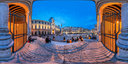
The Palais des Papes in Avignon, Southern France, is one of the largest and most important medieval Gothic buildings in Europe. Once a fortress and palace, the papal residence was a seat of Western Christianity during the 14th century. Six papal conclaves were held in the Palais, leading to the elections of Benedict XII in 1334, Clement VI in 1342, Innocent VI in 1352, Urban V in 1362, Gregory XI in 1370 and Benedict XIII in 1394.
The Popes departed Avignon in 1377, returning to Rome, but this prompted the Papal Schism during which time the antipopes Clement VII and Benedict XIII made Avignon their home until 1403. The latter was imprisoned in the Palais for five years after being besieged in 1398 when the army of Geoffrey Boucicaut occupied Avignon. The building remained in the hands of antipapal forces for some years – it was besieged from 1410 to 1411 – but was returned to the authority of papal legates in 1433. Although the Palais remained under papal control (along with the surrounding city and Comtat Venaissin) for over 350 years afterward, it gradually deteriorated despite a restoration in 1516.
When the French Revolution broke out in 1789 it was already in a bad state when it was seized and sacked by revolutionary forces. In 1791 it became the scene of a massacre of counter-revolutionaries, whose bodies were thrown into the Tour des Latrines in the Palais Vieux. The Palais was subsequently taken over by the Napoleonic French state for use as a military barracks and prison. Although it was further damaged by the military occupation, especially under the anti-clerical Third Republic when the remaining interior woodwork was cleared away for use of the structure as a stables – the frescos were covered over and largely destroyed – this ensured the shell of the building's physical survival.
It was vacated in only 1906, when it became a national museum. It has been under virtually constant restoration ever since. In 1995, the Palais des Papes was classified as a UNESCO World Heritage Site for its outstanding architecture and historical importance for the papacy. [WikiPedia]
France is affectionately referred to as "the Hexagon" for its overall shape.French history goes back to the Gauls, a Celtic tribe which inhabited the area circa 300BC until being conquered by Julius Caesar.The Franks were the first tribe to adopt Catholic Christianity after the Roman Empire collapsed. France became an independent location in the Treaty of Verdun in (843 AD), which divided up Charlemagne's Carolingian Empire into several portions.The French monarchy reached its zenith during the reign of Louis XIV, the Sun King, who stood for seventy-two years as the Monarch of all Monarchs. His palace of Versailles and its Hall of Mirrors are a splendid treasure-trove of Baroque art.The French Revolution ended the rule of the monarchy with the motto "Liberty, Equality, Fraternity!" On July 14th, 1789 angry mobs stormed La Bastille prison and began the Revolution in which Louis XVI, his wife Marie-Antoinette and thousands of others met the guillotine.One decade after the revolution, Napolean Bonaparte seized control of the Republic and named himself Emperor. His armies conquered most of Europe and his Napoleonic Code became a lasting legal foundation for concepts of personal status and property.During the period of colonization France controlled the largest empire in the world, second only to Britain.France is one of the founding members of the European Union and the United Nations, as well as one of the nuclear armed nations of the world.Text by Steve Smith.