

0 Likes
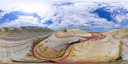
View from atop the West Kennet Long Barrow, a chambered long barrow near Avebury, England. It was constructed around 3650BC during Britain's Early Neolithic period, surviving today in a partially reconstructed state.
Archaeologists have established that the monument was built by pastoralist communities shortly after the introduction of agriculture to Britain from continental Europe. Although representing part of an architectural tradition of long barrow building that was widespread across Neolithic Europe, the West Kennet Long Barrow belongs to a localised regional variant of barrows in Western Britain, now known as the Cotswold-Severn Group. Of these, it is part of a cluster of around thirty centred on Avebury in the uplands of northern Wiltshire.
Built out of earth, local sarsen megaliths, and oolitic limestone imported from the Cotswolds, the long barrow consisted of a sub-rectangular earthen tumulus enclosed by kerb-stones. Its precise date of construction is not known. Human bones were placed within the chamber, probably between 3670 and 3635 BC, representing a mixture of men, women, children, and adults. There is then an apparent hiatus in the use of the site as a place of burial, probably lasting over a century. Between 3620 and 3240 BC it likely began to be re-used as a burial space, receiving both human and animal remains over a period of several centuries. Various flint tools and ceramic sherds were also placed within it during this time. In the Late Neolithic, the entrance to the long barrow was blocked up with the addition of large sarsen boulders. During the Later Neolithic and Early Bronze Age, the landscape around West Kennet Long Barrow was subject to the widespread construction of ceremonial monuments, among them the Avebury henge and stone circles, the West Kennet Avenue, The Sanctuary, and the visible Silbury Hill to the north.
During the Romano-British period, a small coin hoard was buried in the side of the long barrow. The ruin attracted the interest of antiquarians in the 17th century, while archaeological excavation took place in 1859 and again in 1955-1956, after which it underwent reconstruction.
Silbury Hill itself is an artificial chalk mound built around 2400BC, around the time of the Egyptian Great Pyramids. It stands at 129 feet in height, 548 feet in diameter, w/ its flat top at 98 feet in diameter & is the largest man-made mound in Europe. Its exact purpose is unknown as no burial sites have been found within it. In March 2007, a Roman village had been found at the base of the hill, w/ excavations revealing laid-out houses & streets.
From: https://en.wikipedia.org/wiki/West_Kennet_Long_Barrow
https://en.wikipedia.org/wiki/Silbury_Hill
...