Open Map
Close Map
N
Projections and Nav Modes
  • Normal View
  • Fisheye View
  • Architectural View
  • Stereographic View
  • Little Planet View
  • Panini View
Click and Drag / QTVR mode
Compartilhe esta panorâmica
For Non-Commercial Use Only
This panorama can be embedded into a non-commercial site at no charge. Leia mais
Do you agree to the Terms & Conditions?
For commercial use, contacte-nos
Embed this Panorama
LarguraAltura
For Non-Commercial Use Only
For commercial use, contacte-nos
LICENSE MODAL

0 Likes

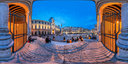
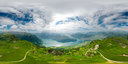
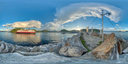
Porto Venere
Liguria, Italy
Porto Venere (Italian pronunciation: [ˈpɔrto ˈvɛːnere]; until 1991 Portovenere; Ligurian: Pòrtivene) is a town and comune (municipality) located on the Ligurian coast of Italy in the province of La Spezia. It comprises the three villages of Fezzano, Le Grazie and Porto Venere, and the three islands of Palmaria, Tino and Tinetto. In 1997 Porto Venere and the villages of Cinque Terre were designated by UNESCO as a World Heritage Site. History The War Memorial Plaque dedicated to Giuseppe Garibaldi The ancient Portus Veneris is believed to date back to at least the middle of the 1st century BC. It has been said that the name refers to a temple to the goddess Venus which was sited on the promontory where the church of Peter the Apostle now stands. The name has also been linked to that of the hermit Saint Venerius. In Roman times the city was essentially a fishing community. After the fall of the Western Roman Empire, Porto Venere became the base of the Byzantine fleet in the northern Tyrrhenian Sea, but was destroyed by the Lombards in 643 AD. Later, it was a frequent target of Saracen raids. First indications of the existence of a castle date from 1113, and in 1161 the walls were erected. Porto Venere became a fiefdom of a family from Vezzano before passing to Republic of Genoa in the early 12th century. In 1494, it suffered a devastating bombardment from the Aragonese fleet during their war with Genoa: subsequently the old part of the town declined in importance, giving way to the development of the Borgo Nuovo ("New District"), which had existed from 1139 and is centred on the church of St. Peter. On 2 December 1797, after the French established their domination in Italy, the town became part of the Department of the Gulf of Venus, with the capital in La Spezia, in the Ligurian Republic annexed to the First French Empire. From 28 April 1798 with the new French law, the territory of Portovenere fell in the seventh canton, as the capital, the Jurisdiction of the Gulf of Venus since 1803 and the main center of the third State of the Gulf of Venus in the jurisdiction of the Gulf of Venus. From 13 June 1805 to 1814 it was included in the Department of the Apennines. It was at this point which, in 1812, it became part of the coastal route called "Route Napoleon" in honor of the French general and now known as localized road 530, which still connects the marine center with La Spezia via Fezzano, Le Grazie and Terizzo. In 1815 it was incorporated in the Kingdom of Sardinia, according to the decisions of the Congress of Wien of 1814, and subsequently in the Kingdom of Italy from 1861. From 1859 to 1927 the territory was included in the First district of La Spezia, part of the Eastern District of the Province of Genoa before and, with its establishment in 1923, the Province of La Spezia. In 1998 it obtained for its architectural heritage and natural entry in the list of protected World Heritage Site, with the Rolli in Genoa's historic center, one of only two Ligurian sites, and in 2001 established the eponymous Regional Natural Park. https://en.wikipedia.org/wiki/Porto_Venere
Copyright: Frank Ellmerich
Type: Spherical
Resolution: 16000x8000
Taken: 29/05/2025
Uploaded: 08/10/2025
Published: 08/10/2025
Visitas:

...


Tags: italien; italy; porto; venere; cinque; terre; 5; mediterrane; see; sea; mittelmeer; genua; ligurien; liguria; ligurian; italian; la; spezia; pisa; genoa; golf; gulf
More About Liguria, Italy

Liguria borders France to the west, Piedmont to the north, and Emilia-Romagna and Tuscany to the east. It lies on the Ligurian Sea. Liguria is a narrow strip of land, enclosed between the sea and the Alps and the Apennines mountains, it is a winding arched extension from Ventimiglia to La Spezia and is one of the smallest regions in Italy. Its surface area is 5,416.03 square Kilometres, corresponding to 1.18% of the whole national surface area, with the following subdivision: 3524.08 kilometres mountain (65% of the total) and 891.95 square kilometres hill (35% of the total).Its shape is that of a thin strip of land, from 7 to 35 Km wide (respectively above Voltri and in the high mountain area around Imperia), on average about 240 Km long, lying in a semicircle around the Ligurian Sea and with convexity facing north; comprised between the sea and the watershed line of the Maritime Alps and the nothern Apennines, which at some points it crosses (for example in the Savona and Genoa mountains). Some mountains rise above 2000 m.; the watershed line runs at an average altitude of about 1.000 metres.The continental shelf, which is very narrow, goes down almost immeditely to considerable marine depths. The coastline is 315 Km long. Except for the Portovenere and Portofino promontories, it is generally not very jagged, and is often high and compact. At the mouths of the biggest watercourses there are small beaches, but there are no deep bays and natural harbours except for those of Genoa and La Spezia.The hydrographic system is made up of the short watercourses of a torrential kind. In the coastal part the most important are the Roja (in its lower course), the Nervia, and the Magra. On the inland side we find some tributaries of the Po: the two branches of the Bormida, the Scrivia and the Trebbia; there is not much water in these rivers, though the quantity increases greatly in rainy periods.The ring of hills, lying immediately beyond the coast, together with the beneficial influx of the sea, account for the mild climate the whole year round (with average winter temperatures of 7-10° and summer temperatures of 25-28°) which makes for a pleasant stay even in the heart of winter.Rainfall can be very abundant at times; mountains very close to the coast create an orographic effect, so Genoa can see up to 2000 mm of rain in a year; other areas instead show the normal values of the Mediterranean area (500-800 mm). Despite the high population density, woods cover half of the total area. Liguria's Natural Reserves cover 12% of the entire Region, i.e. around 60,000 hectares of land, and they are made up of one National Reserve, six large parks, two smaller parks and three nature reserves. http://en.wikipedia.org/wiki/Liguria
It looks like you’re creating an order.
If you have any questions before you checkout, just let us know at [email protected] and we’ll get right back to you.